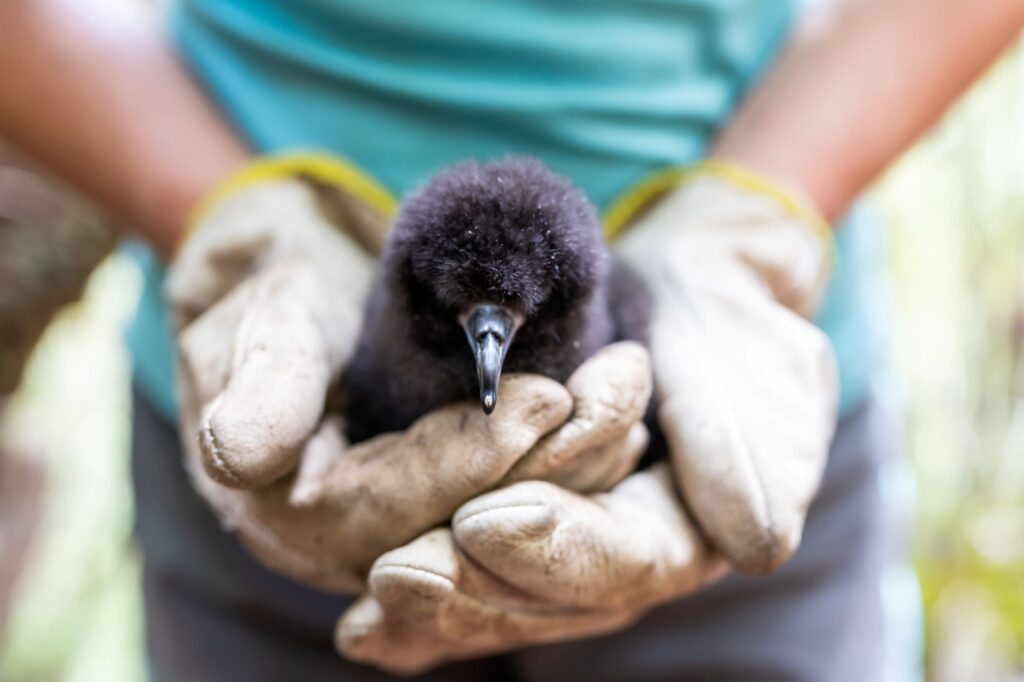
Funded in part by the Live Ocean community, the project marks a major step forward in protecting one of Aotearoa’s rarest seabirds.
Researchers explain latest findings from largest tākoketai black petrel study
By Live Ocean
23 July '26
Read time: 3 min
Article Summary
Main Points
New tracking devices are revealing the full migration of endangered tākoketai black petrels for the first time, uncovering new behaviours and unexpected routes across the Pacific.
The data has also exposed the risks young birds face, including disorientation from artificial light, helping researchers better understand threats to the species.
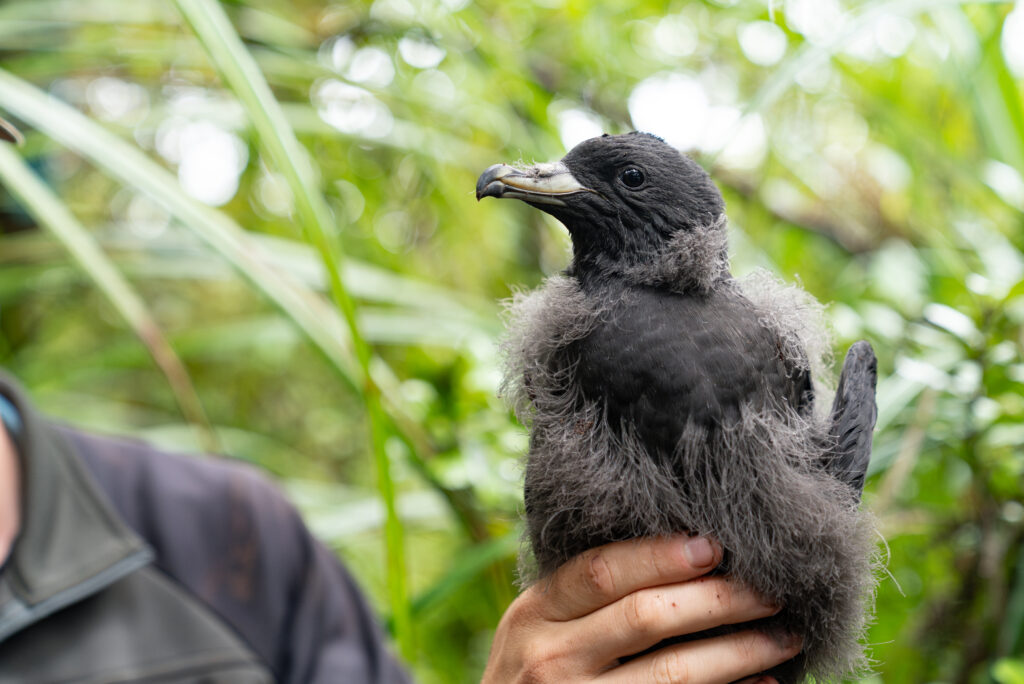

For years, tracking the migration of tākoketai black petrel was a race against the battery. Devices lasted only a couple of months – long enough to watch a chick leave the colony, but not long enough to see where its journey truly ended.
That has changed. Thanks to an unprecedented tracker deployment (the largest ever in black petrel history) – made possible in part by fundraising from the BNZ Foundation, the Lou and Iris Fisher Charitable Trust, and others in the Live Ocean community – researchers can now follow individual chicks for up to a year, all the way across the Pacific and into the waters where they spend the winter.
The result is a window into a part of these birds’ lives that has never been seen before, and the current season of data is already rewriting what we thought we knew.
The tākoketai black petrel, breeds on just two islands in the world – Aotea (Great Barrier Island) and Hauturu (Little Barrier Island) both located in Tīkapa Moana, the Hauraki Gulf. Each year the newly fledged chicks set off alone on an extraordinary journey across the Pacific to the rich, cold waters off the coast of South America, where they will spend the winter and the next year of their lives feeding.
Until now, researchers could only watch the very start of that journey before the trackers fell silent. The new devices change everything.
“Previously, we had devices that only lasted a couple of months,” explains Biz Bell, Managing Director and Lead Researcher at Wildlife Management International, who has monitored tākoketai on Aotea since 1995. “Now we’ve got devices that are going to last up to a year – which means not only are we tracking them all the way across their flights to South American waters, we’re now getting to see what they get up to in those waters. This is all groundbreaking stuff.”
And what they are getting up to has surprised everyone. This season, chicks have ranged much further north than ever recorded before. Some are already foraging off Ecuador and around the Galapagos Islands; others are working their way up and down the Ecuadorian and Peruvian coasts. A few are still out in the open Pacific, cruising at roughly the same latitude as Guatemala, somewhere between Hawaii and the Pitcairn Island group – in no hurry at all.
“It’s really interesting behaviour which we didn’t know they did,” says Bell. “I always thought they just sort of hung around the Humboldt Current – but not this year.”
A dangerous first flight
The longer view has also revealed just how perilous that first migration can be. This year, around 11 chicks headed the wrong way – instead of turning east for South America, they were drawn west across Aotearoa. Researchers think they’re distracted by artificial light.
One chick fledged from Aotea, flew into the Hauraki Gulf, appears to have been pulled off course by the lights of Auckland, then crossed the island to the West Coast, tracked all the way down past Taranaki towards Cook Strait before realising its mistake, doubling back to Auckland, waiting for dark, and crossing the divide a second time. In the end, that single bird flew around 600 kilometres further than it needed to.
Another, nicknamed Whā Tekau, fledged from Little Barrier Island in mid-May and detoured into Whangārei Harbour before finally striking out on the right heading. Researcher Simon Lamb, walking through the tracking data, points to one bird after another taking the scenic route: “This is another bird that went completely the wrong direction – instead of going east like it normally should have, it goes all the way down to the Firth of Thames, crosses the country, goes west… before figuring out, oh, I can go east.”
And then there is Rua, who ignored South America entirely and turned up on the Gold Coast of Australia – “having a very relaxing time,” as Bell put it, in the hope he eventually points himself back east.
These detours are more than curiosities. Some chicks did not make it – a couple were lost on the New Zealand coastline after becoming disorientated by lights and ending up on beaches. It is a stark reminder of the impact of light pollution on seabirds, and exactly the kind of insight these longer-lasting trackers were built to capture.
Researchers also noted that a few devices have stopped transmitting. Bell explains that “this could be either because the devices have fallen off at sea or the chicks have pulled them off, or unfortunately the chicks may have died on migration.”
Why this matters – and thank you
Every one of these discoveries is possible because the trackers now stay with the birds for the full journey. For the first time, researchers can begin to answer the most basic questions about where tākoketai go, what routes they take, and what dangers they face along the way – knowledge that is essential to protecting the species.
None of it would be happening without the people who backed this work. The trackers behind this season’s breakthroughs were funded in part by the Live Ocean community, whose support turned an idea into a year of data and a genuine leap forward in understanding one of Aotearoa’s most remarkable ocean travellers.
To everyone who gave: thank you. You are, quite literally, helping us follow these birds across the ocean.
The project is guided by Ngāti Rehua Ngātiwai ki Aotea and Ngāti Manuhiri as kaitiaki of the tākoketai, and brings together researchers, conservation groups, councils, fishers and international collaborators across the Pacific Flyway.
Thank you to the BNZ Foundation, the Lou and Iris Fisher Charitable Trust, the Black Foils and everyone who supported our 2025 Christmas fundraising campaign to help fund these trackers and bring this research to life.
Thank you also to the Department of Conservation, the Conservation Services Programme and Auckland Council, for the ongoing support of the Wildlife Management International research team which has made this work possible.