PROJECTS /
Project Summary
A long-term research and tracking project uncovering the migration secrets of tākoketai black petrel to drive smarter conservation across the Pacific.
With only around 5,000 breeding pairs remaining, the tākoketai is one of our most at-risk seabirds, facing threats from fishing bycatch and habitat loss.
Charting a course to recovery – by investing in science, storytelling, and community action, we can give these seabirds a fighting chance.
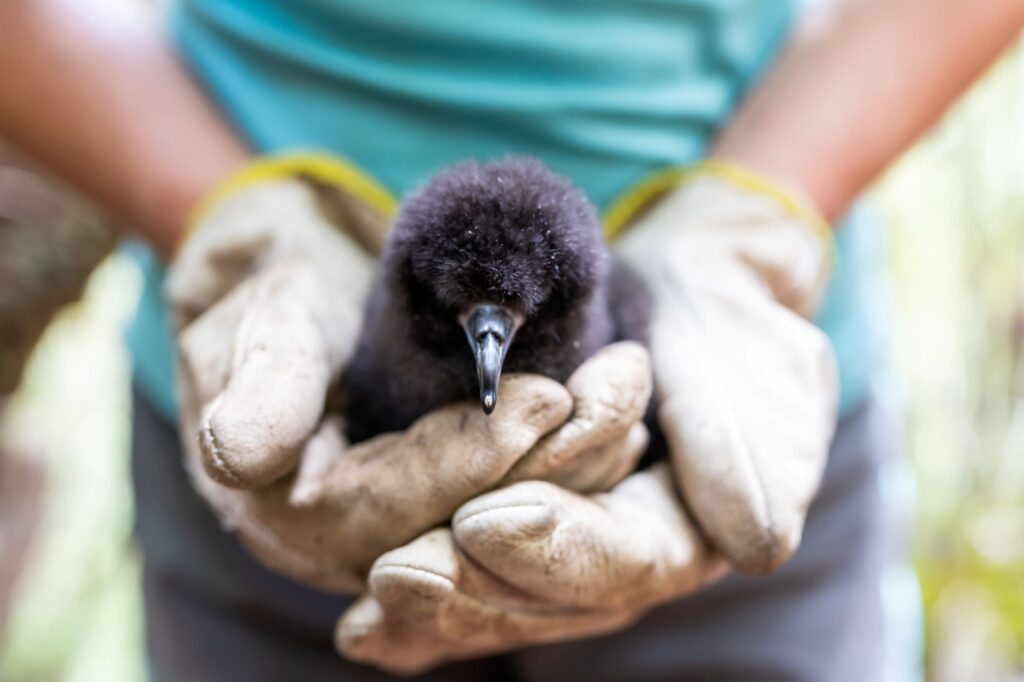
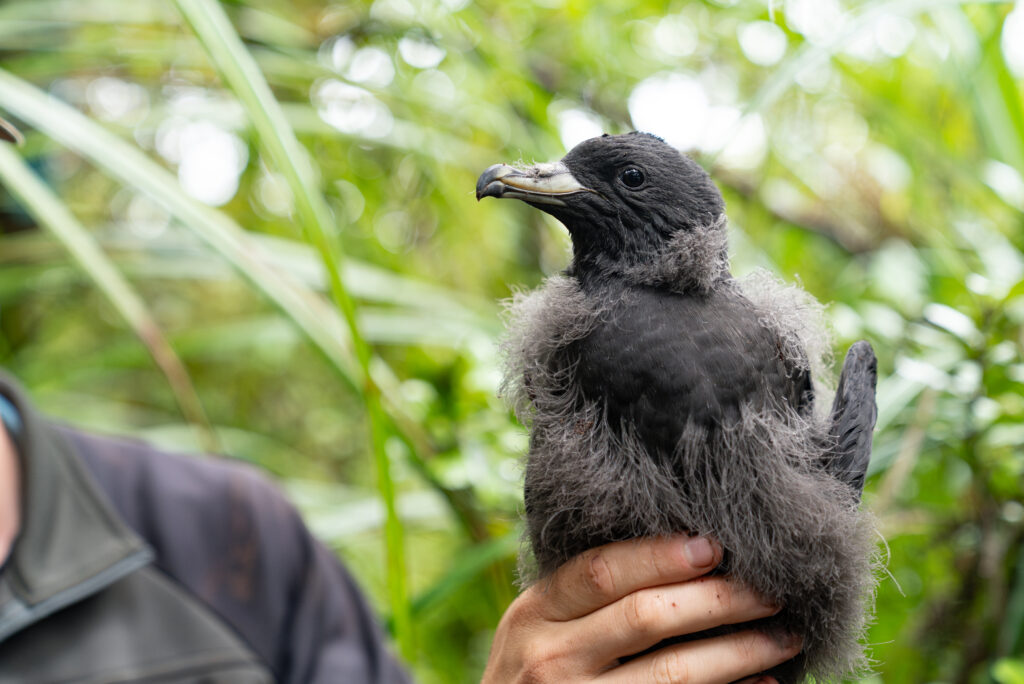
The story of the tākoketai black petrel is one of vulnerability and hope. Each year, newly fledged chicks embark on their first extraordinary migration. They take off from their home in the Hauraki Gulf and fly 1,000’s of kms across the Pacific to Ecuadorian waters. Yet fewer than 10% return, and much about their journey remains a mystery.
Sleek and entirely black, with an impressive 1.1 metre wingspan, these endemic seabirds were once widespread across Te Ika-a- Māui, the North Island of Aotearoa New Zealand. Today, they nest only on Aotea Great Barrier Island and Te Hauturu-o-Toi Little Barrier Island.
After spending several years roaming the open ocean, these small but resilient voyagers return home to breed, pairing up for life and digging burrows close to the very spot they hatched – some even attempt to move back in with their parents!
With only around 5,000 breeding pairs remaining, the tākoketai is one of our most at-risk seabirds, facing threats from fishing bycatch, predation, light pollution and habitat loss.
Protecting them is vital not only because they are unique to Aotearoa, but because as a sentinel species, their fate reflects the health of the wider ocean they depend on.
Biz Bell
Wildlife Management International
This project aims to reverse the decline of the tākoketai black petrel population through tracking their migration, international collaboration, and advocacy. By supporting long-term research, developing mitigation strategies, and building partnerships across the Pacific Flyway, Live Ocean and its partners aim to rebuild the population to enable future translocation into historic habitats.
IN NUMBERS
Breeding pairs left
breeding locations remain
of these birds ever return home. Where the others go remains a mystery
Black petrels have a 1.1m wingspan
By investing in science, storytelling, and community action, we can give these seabirds a fighting chance – protecting a vital part of Aotearoa’s natural heritage and inspiring collective responsibility for the ocean that connects us all.
Credit: Ed Marshall
Credit: Dan Burgin
Black petrel monitoring starts on Aotea Great Barrier Island.
With the support of Ngāti Rehua, WMIL has been contracted by DOC and the Ministry of Primary Industries to carry out tākoketai black petrel monitoring work at their two known breeding locations, Aotea Great Barrier Island and Te Hauturu-o-Toi Little Barrier Island.
Black petrels are classified as “Nationally Vulnerable” by the New Zealand Threat Classification System
Start of black petrel monitoring on Te Hauturu-o-Toi, Little Barrier Island with the support of Ngāti Manuhiri by Auckland Council.
Live Ocean in partnership with the BNZ Foundation commit to supporting the project to fund research, monitoring, and conservation action.
The largest ever black petrel tracking programme begins with 50 trackers deployed on fledglings from Aotea Great Barrier Island and Te Hauturu-o-Toi, Little Barrier Island.
These trackers are following the birds on their first voyage across the Pacific to Ecuador, and will provide insights for up to a year.
The project is guided by Ngāti Rehua Ngātiwai ki Aotea and Ngāti Manuhiri as kaitiaki of these tākoketai.
Huge thank you to the BNZ Foundation, the Lou and Iris Fisher Charitable Trust, the Black Foils and everyone who supported our 2025 Christmas fundraiser to help fund these trackers and bring this research to life.
Wildlife Management International‘s field work was partially funded by Auckland Council and the Conservation Services Programme, with additional support directly from the Department of Conservation. The Conservation Services Programme is partially funded by the Aotearoa commercial fishing industry, and we acknowledge and thank fisheries for their contribution to the ongoing support of the science team which has made this work possible.
Managing Director, Wildlife Management International
As Senior Ecologist and Director at Wildlife Management International Limited (WMIL), Elizabeth (Biz) Bell is a leading force in ecological restoration and predator eradication. With decades of experience delivering significant biodiversity gains in Aotearoa New Zealand and globally, Biz is an expert at island restoration. Her mahi has driven the success of 30 island eradications, and 20 feasibility studies across regions like the Pacific, Caribbean, and Europe. A seabird specialist, Biz has undertaken one of Aotearoa’s longest running seabird research projects – monitoring tākoketai black petrels on Aotea Great Barrier Island since 1995.

We’re on a mission to create 1,000 postcards to protect the Hauraki Gulf and we need your help.
Send us your favourite ocean photo and a few words about what you love most about the Gulf, and together, we’ll spotlight why the Gulf deserves urgent protection – for us, and for future generations.